It’s 9:40 on a Tuesday night in Ballard. A woman who’s been thinking about morpheus8 for three months finally lands on your Seattle med-spa’s website. She reads your treatment page, scrolls your before-and-afters, and gets to the one question that decides everything: “How much is a package, and can I get in this weekend?” There’s no one to ask. Your front desk closed at six. She fills out nothing, books nothing, and by the time your team sees the site the next morning, she’s already scheduled a consult at the studio down the street whose chat bubble answered her in nine seconds.
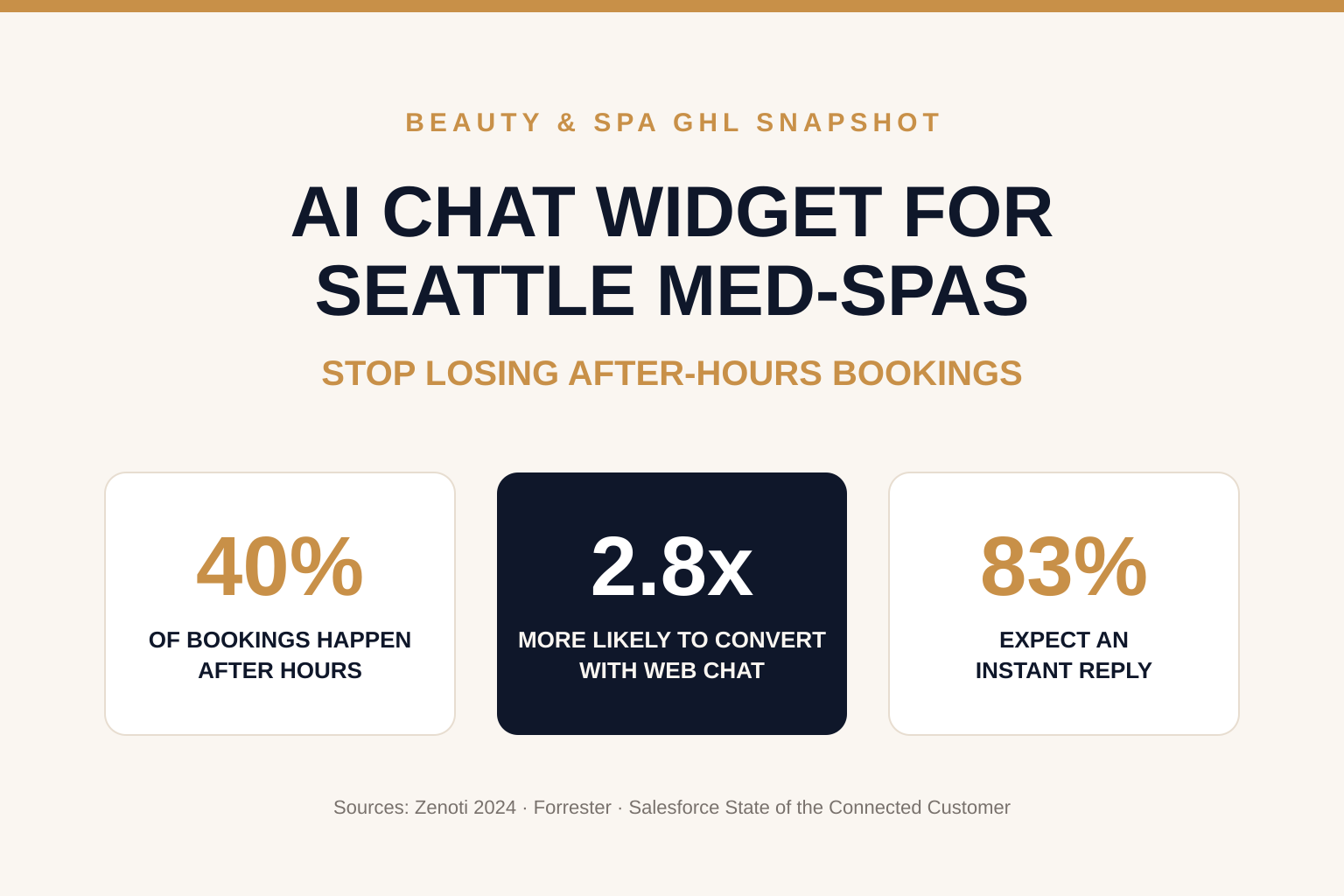
The short answer: the single most profitable fix for a Seattle med-spa’s website is an AI chat widget that answers treatment and pricing questions and books the appointment 24/7 — because 40% of spa appointments are booked after business hours (Zenoti, 2024), 48.7% of website visitors leave without interacting at all (Contentsquare, 2024), and visitors who use web chat are 2.8× more likely to convert (Forrester). This article breaks down exactly where the bookings leak — and how to plug it without adding a single hour to your front desk.
Table of contents
- Why your Seattle med-spa’s website leaks bookings
- The four hidden leaks in a spa website
- What an AI chat widget actually does
- No widget vs. AI chat widget
- What it’s worth to a Seattle med-spa
- Setting it up right (compliance + brand voice)
- Frequently asked questions
Why your Seattle med-spa’s website leaks bookings
Seattle is one of the most competitive aesthetics markets on the West Coast — home-grown brands like SkinSpirit set a high bar, and new injectable studios open in Bellevue, Capitol Hill, and Ballard every quarter. Nationally, the medical-aesthetics market reached $4.1 billion in 2024 and is growing nearly 9% a year (IMARC Group). Demand isn’t your problem. What happens after someone lands on your site is.
Here’s the uncomfortable math. The average website bounce rate in 2024 was 48.7% (Contentsquare 2024 Digital Experience Benchmark) — nearly half of every visitor leaves without clicking anything. Of the ones who stay, most have a specific, high-intent question — what does it cost, am I a candidate, can I get in Saturday — and a static page doesn’t answer it. Meanwhile 83% of customers now expect to engage with someone immediately when they contact a company (Salesforce, State of the Connected Customer). A “Contact us — we’ll reply within 24 hours” form is the opposite of that promise.
The result is a slow, invisible leak. You pay for the ads, the SEO, the Instagram content that drives traffic to the site — and then lose the highest-intent visitors at the exact moment they’re ready to act, simply because nobody was there to say “yes, we have Saturday at 2, want me to hold it?”
The four hidden leaks in a spa website
Every leak below is a place where a ready-to-book Seattle client quietly disappears. An AI chat widget seals all four.
1. The after-hours black hole
40% of appointments are booked after business hours (Zenoti, 2024) — evenings, lunch breaks, and Sunday nights, when someone finally has a quiet moment to research a treatment. That’s precisely when your phone rings out and your contact form goes to an inbox no one is watching. Half of your loyal clients (50%) already say limited booking hours are very or extremely frustrating. The demand is arriving; the door is locked.
2. The “just browsing” bounce
With a 48.7% bounce rate, nearly half your visitors leave without a click. Many of them had one small blocker — they couldn’t find the price of a lip-filler package, or weren’t sure if they were a candidate for laser on their skin tone. A static page can’t reassure them. A chat widget that proactively opens with “Questions about pricing or which treatment fits? Ask me anything” turns a silent bounce into a conversation.
3. The form-fill friction
The traditional path — fill out a form, wait for a callback — asks the client to do the work and then wait. In a market where 83% expect an immediate response, that lag is fatal. Every field you add and every hour you make them wait sheds ready buyers.
4. The slow-reply lag during treatment hours
Even during open hours, your injector is in a room and your front desk is checking someone out. The website chat asking “how much is Botox?” sits unanswered for twenty minutes — long enough for that visitor to open three competitor tabs. Speed isn’t a nicety in aesthetics; it’s the whole game.
What an AI chat widget actually does
An AI chat widget isn’t a scripted “Press 1 for hours” bot. It’s a trained assistant that lives on your website (and, in the same system, your Instagram and Facebook Messenger) and does four things a closed front desk can’t:
- Answers in your voice, instantly. Trained on your treatment menu, pricing, hours, and policies, it responds in seconds — 24/7. Consumers say 24/7 availability is the single best thing about chat (Tidio, 2024).
- Resolves the routine questions. Modern AI chat independently resolves roughly two-thirds of routine inquiries without a human (Tidio) — pricing, candidacy, aftercare, parking, “do you take my area of Seattle.”
- Qualifies and books. It reads intent (new client, existing client, question, or booking), offers real open slots from your live calendar, and confirms the appointment inside the chat — optionally collecting a deposit or card-on-file to protect against no-shows.
- Hands off when it should. Anything sensitive, medical, or complex is escalated to a human with the full transcript, so nothing clinical is ever answered by a bot.
The whole point isn’t to replace your team — it’s to give them a tireless first responder so a 9:40 p.m. message becomes a confirmed 11 a.m. Saturday consult by the time anyone reads it.
This is the same AI assistant that powers the AI chatbot module in our snapshot and connects to the appointment automation and missed-call text-back systems — one inbox, one calendar, one client timeline.
No widget vs. AI chat widget
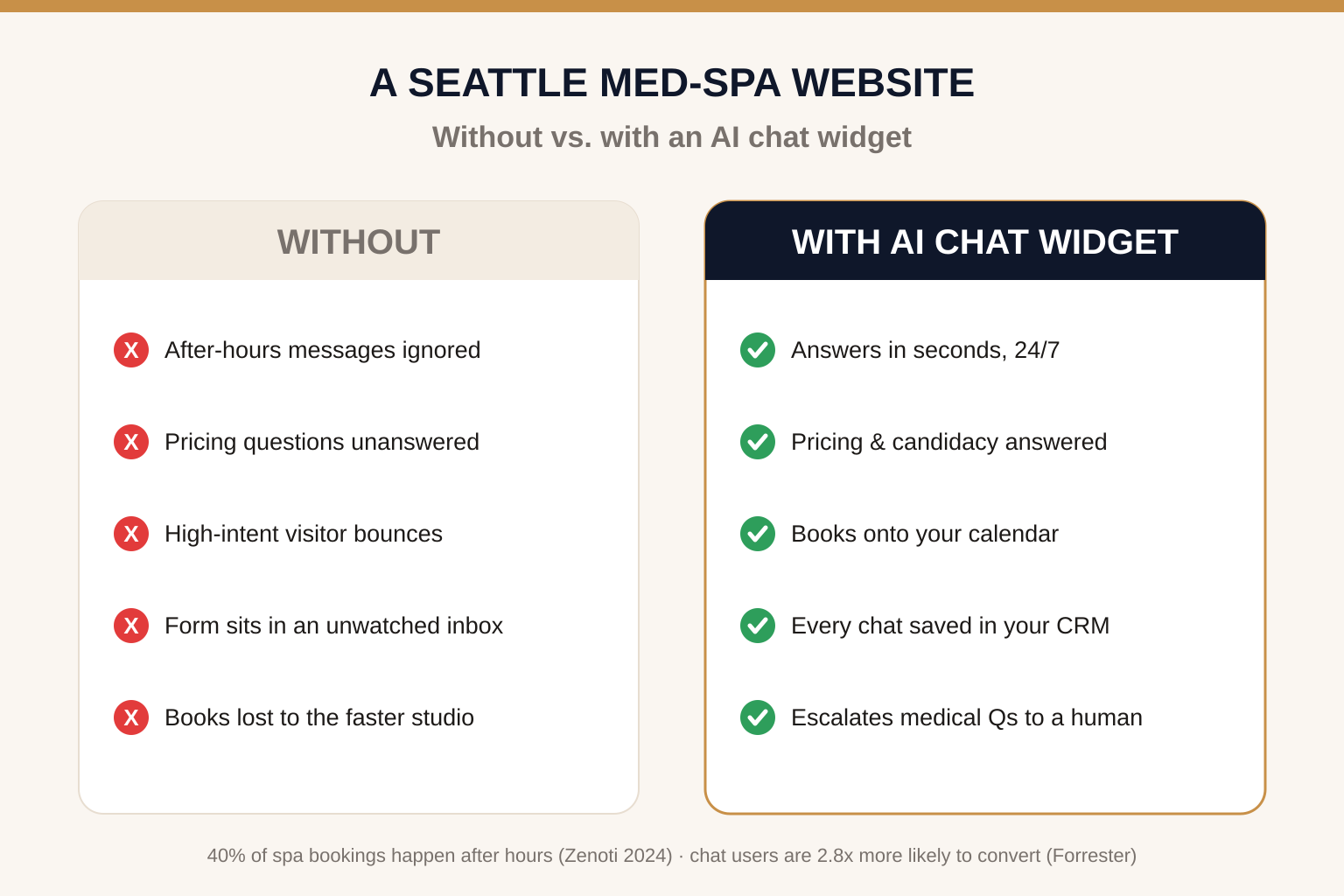
A Seattle spa website: contact form vs. AI chat widget
| Plan | Contact form / phone only | AI chat widget recommended |
|---|---|---|
| Price | Business hours | 24/7 |
| Feature 1 | Replies next business day — if at all | Answers in seconds, any hour |
| Feature 2 | Silent after 6 p.m. and on weekends | Open all night, every weekend |
| Feature 3 | Pricing questions go unanswered | Prices, candidacy & aftercare answered |
| Feature 4 | Client does the work, then waits | Books inside the conversation |
| Feature 5 | High-intent visitors bounce | Turns bounces into consults |
| Feature 6 | No record of who asked what | Every chat saved as a contact in GHL |
| The status quo | See the AI chat widget → |
What it’s worth to a Seattle med-spa
Let’s run conservative numbers. Say your Seattle studio gets 1,200 website visitors a month from ads, SEO, and social. At a typical 2.5% booking rate, that’s 30 booked consults. Now assume your chat widget engages even a modest 12% of visitors, and — per Forrester’s 2.8× lift — those chatters convert far better. Capture just 20 extra consults a month from traffic you already pay for, and the picture changes fast.
If your average new-client value — first treatment plus the packages and rebookings that follow — is $500, those 20 extra consults are roughly $10,000 a month, or about $120,000 a year, from visitors you were already attracting. No extra ad spend. You simply stopped letting after-hours, high-intent clients slip away unanswered. (It’s the same speed-to-lead economics that make missed-call text-back and client reactivation so profitable.)
Setting it up right (compliance + brand voice)
An AI chat widget for a medical-aesthetics business has to be set up with more care than a retail bot. Get these five things right and it makes you look more premium, not less:
- Train it on your real answers. Feed it your treatment menu, prices, hours, and — importantly — your actual tone. A stiff, generic bot reads as spam and costs you the polished feel Seattle clients expect.
- Book consults, never diagnose. For injectables, lasers, and anything medical, the widget books a consultation. It never promises a clinical result, diagnoses, or gives scope-of-practice advice. That’s both compliance and good taste.
- Consent before you text. If the chat collects a phone number to text a reminder or confirmation, capture explicit opt-in and honor STOP immediately — standard TCPA practice.
- Always offer a human handoff. Route complaints, medical concerns, and anything nuanced to a real person with the full transcript. Automation handles volume; humans handle judgment.
- Measure booked-from-chat. Tag every appointment the widget books so you can see, in dollars, what it’s returning — and double down.
Your website is the one storefront that never closes. The Seattle studios that win the next year won’t be the ones with the flashiest homepage — they’ll be the ones that answer the 9:40 p.m. question in nine seconds and hold the Saturday slot before the client can second-guess it. An AI chat widget is how you become that studio without adding a single hour to your day.
Frequently asked questions
AI chat widget for Seattle med-spas — FAQs
What is an AI chat widget for a med-spa website?
It's a trained AI assistant that lives on your website (and can share the same brain with your Instagram and Facebook Messenger). It answers treatment and pricing questions in your brand voice, qualifies the inquiry, and books the appointment straight onto your calendar — 24/7. Unlike a static contact form, it responds in seconds, which matters because 83% of customers now expect to engage immediately when they contact a business (Salesforce).
Will an AI chat widget really book more consults for my Seattle spa?
The data is strong: Forrester found visitors who use web chat are 2.8x more likely to convert, and 40% of spa appointments are booked after business hours (Zenoti, 2024) — exactly when a form sits unanswered. By engaging high-intent visitors before they bounce (the average website bounce rate is 48.7%), a chat widget recovers bookings you're currently losing from traffic you already pay for.
Is an AI chat widget safe for a medical-aesthetics business?
Yes, when it's set up correctly. For any medical treatment the widget books a consultation rather than diagnosing or promising a result, and it escalates anything sensitive to a human with the full transcript. If it collects a phone number, it follows TCPA best practice — explicit opt-in and honoring STOP. Configured this way, it keeps you inside scope of practice and looks more professional, not less.
Will it sound like a robot to my clients?
Not if it's trained properly. The assistant learns from your real replies, your treatment menu, your prices, and your tone, so it reads like your best front-desk person — warm, on-brand, and accurate. You review and approve the voice before it goes live, and anything it can't confidently handle is instantly handed to a human.
Do I need GoHighLevel to run an AI chat widget?
GoHighLevel is what we build it on — it connects your website chat, Instagram, and Messenger into one inbox, runs the AI assistant, and ties into your calendar and CRM so every chat becomes a saved contact. Our done-for-you snapshot installs and configures the whole system for you, so you don't have to build it yourself.
How fast can it go live?
Because the snapshot is a pre-built system, an AI chat widget typically goes live in days, not the months an agency would take to build one from scratch. We train it on your studio's specifics, connect your calendar, set the compliance guardrails, and turn it on. You can book a 15-minute walkthrough to see it running in a real account first.
Camila Reyna is a spa automation strategist who spent nine years running the front desk and then the marketing for a three-location med-spa group before moving full-time into GoHighLevel build-outs. She writes about the booking funnels, deposit flows, and rebooking sequences that turn a first-time visitor into a member — her rule: if an automation doesn’t fill a treatment room, it doesn’t ship.
Related reading: Speed-to-lead for spas · Missed-call text-back for spas · Instagram & Facebook DM automation · How to reduce spa no-shows