

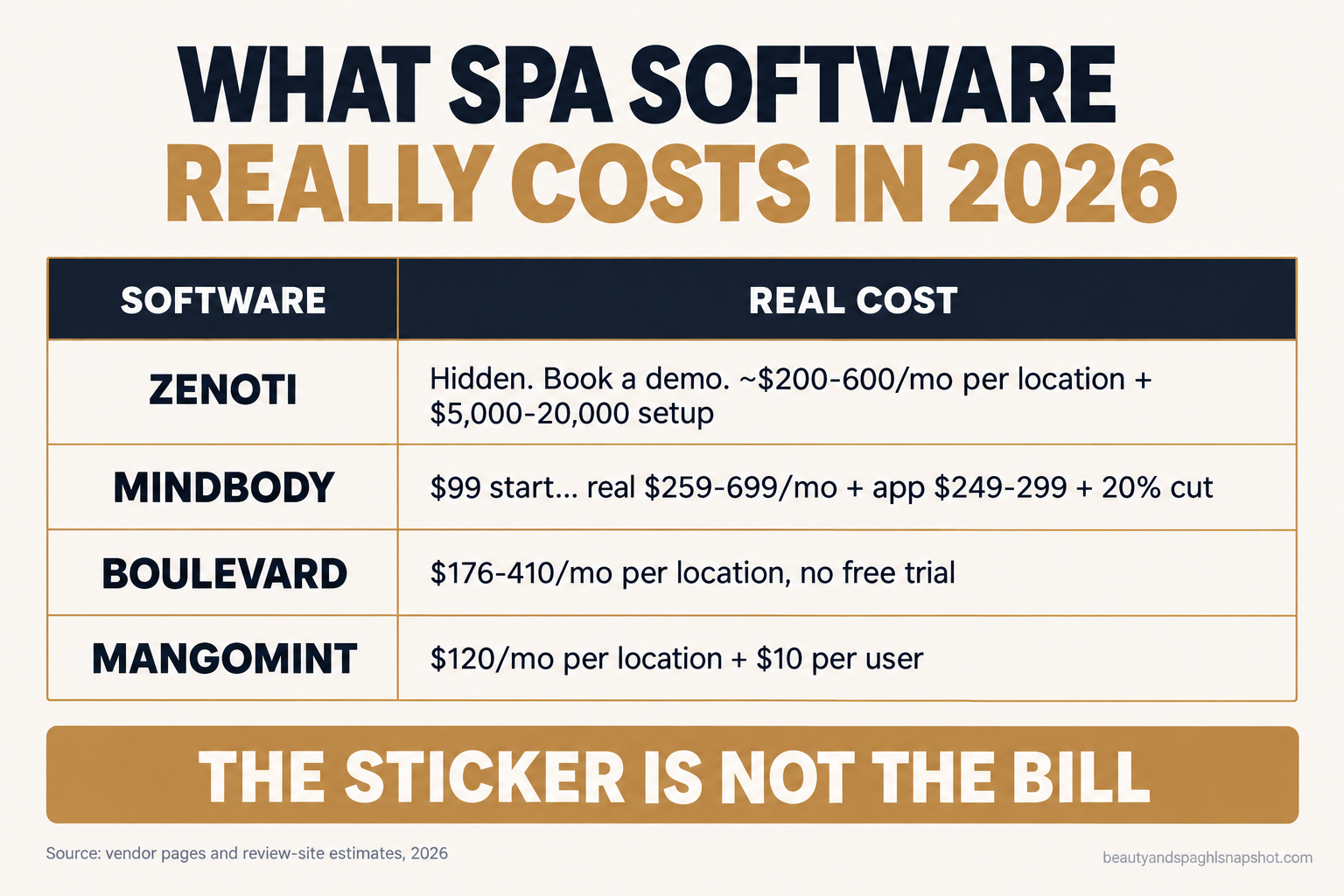
You find Zenoti on a “best spa software” list, click through to price it out, and hit a wall. No plans, no numbers, just a sleek page and one button: Book a Demo. You fill out the form, a rep calls, and forty minutes later you still do not have a price, you have a follow-up meeting. That is not an accident, it is the pricing strategy.
Here is the short version. Zenoti does not publish pricing because the number is big, variable, and easier to defend in a sales call than on a web page. Based on third-party review sites and user reports, a single location runs roughly $200 to $600 per month, with a one-time implementation fee most owners put between $5,000 and $20,000 before you book a single client. It is enterprise software priced for chains. Here is what Zenoti actually costs, why the biggest names all blur their real price, and how to force an honest all-in quote out of any of them before you sign.
On this page
- Why Zenoti won’t tell you the price
- What Zenoti actually costs in 2026
- The sticker is not the bill: every major vendor
- The five places the bill balloons
- What it costs for a solo, a mid-size, and a chain
- Steal this: how to force a real written quote
- Common objections, answered straight
- Frequently asked questions
Why Zenoti won’t tell you the price
Hidden pricing is a choice, and it tells you who the software is for. A vendor that publishes a flat price is confident it will not scare off its buyer. A vendor that hides the price has a number high enough that it needs a salesperson to frame it first.
Zenoti is built for chains and large multi-location spas, and it prices accordingly. The pricing page is a lead-capture form, not a rate card. The logic: get the owner on a call, map their locations, users, and add-ons, then quote a custom number anchored against the revenue the platform claims it will unlock. A $400-per-location fee sounds very different after a rep has spent thirty minutes on the extra bookings you will capture, and that reframing cannot happen on a public page.
The problem for you, trying to budget, is that you cannot compare. The only honest cell you can fill in a spreadsheet is “unknown, book a demo.” AmSpa reports the medical aesthetics industry has eclipsed $17 billion and is growing by more than $1 billion a year (AmSpa), and demo-gated pricing is one way enterprise vendors capture owners who are flush, busy, and shopping fast. None of this makes Zenoti a bad product. For a 10-location chain with an operations team, it is serious software. It is a bad fit for most of the owners who find it, because the wall is built to pull in a much bigger business.
What Zenoti actually costs in 2026
Since Zenoti will not say, the numbers below come from review aggregators and user reports, not a rate card. Read them as a range, not a quote.
The monthly subscription. Estimates cluster between $200 and $600 per month per location. Software Finder puts the start at $225 to $400, Capterra lists around $300, The Salon Business gives configurations at roughly $350, $450, and $500, and Pabau notes owners on Reddit pinning it near $600. For a large chain, ITQlick estimates $10,000 to $15,000 a month at around 100 users.
The implementation fee. The part that catches people, because no other category of spa software front-loads a cost like this. Estimates run from $1,500 to $5,000 on the low end (ITQlick, Pabau) up to $5,000 to $20,000 or more (Glossystack, Software Finder), data migration sometimes billed separately. A one-time charge, due before you are live.
The add-ons. Pabau’s teardown lists two-way texting at $29 to $169 a month and AI chatbots at $150 to $400 a month. ITQlick’s blunt summary: after add-ons and annual price hikes, the real cost often lands three times higher than the first quote.
Reported Zenoti monthly cost per location, 2026 (Software Finder, Capterra, The Salon Business, Pabau). Zenoti does not publish pricing, so every figure is an estimate. Setup fees and add-ons are separate.
As one Capterra reviewer put it, “with all the add ons there is extra cost especially when you have multicentres.” The subscription is the start of the conversation, not the end.
The sticker is not the bill: every major vendor
Zenoti hides everything, so it is the clearest case. The more interesting story is the vendors that publish a price, because the number still is not the bill. Here is where the big names land in 2026.
| Vendor | What you see | What you actually pay |
|---|---|---|
| Zenoti | “Book a demo” | ~$200-600/mo per location + $5K-20K setup + add-ons |
| Mindbody | “Starting at $99/mo” | Accelerate ~$259-279, Ultimate ~$499-699, + branded app $249-299, + 20% marketplace cut, + long contract |
| Boulevard | $176-410/mo per location | No free trial, ~$495 onboarding, per-location billing, aesthetics bundle ~$421 for med spas |
| Mangomint | $120/mo per location | + $10/mo per user, + $70/mo per phone line, + payroll $50/mo |
| Vagaro | ~$24-84/mo | + 2.2-3.5% processing, + texting, forms and website as paid add-ons |
Mindbody is the one to study, because its sticker is the most misleading. The public page shows “Starting at $99 USD/month per location,” then puts “Let’s talk” buttons on the real tiers (G2). Operator reports put Accelerate around $259 to $279 and Ultimate from $499 up to $699 (FitBudd). On top of that sit a separate branded app near $249 to $299 a month, a 20% marketplace commission on app bookings, card processing, and commonly a 24-month contract with a ~$500 data-export fee owners discover only at cancellation (Koalendar). The “$99” is real. The bill for a working 2-location studio is nowhere near it.
Boulevard at least publishes tiers: Essentials, Premier, and Prestige, reported between $176 and $410 per location per month (Capterra). But there is no free trial on any tier, onboarding runs about $495 one-time, and med spas need the aesthetics bundle (around $421) for clinical charting (Pabau). Every location bills at the full rate.
Mangomint just rewrote its model. As of August 1, 2026, it dropped its three flat tiers ($165, $245, $375) for $120 per location plus $10 per user per month, with a solo provider at $130 (Mangomint). One of the more honest pages in the category, and it still proves the rule: $120 is not what a staffed shop pays.
The five places the bill balloons
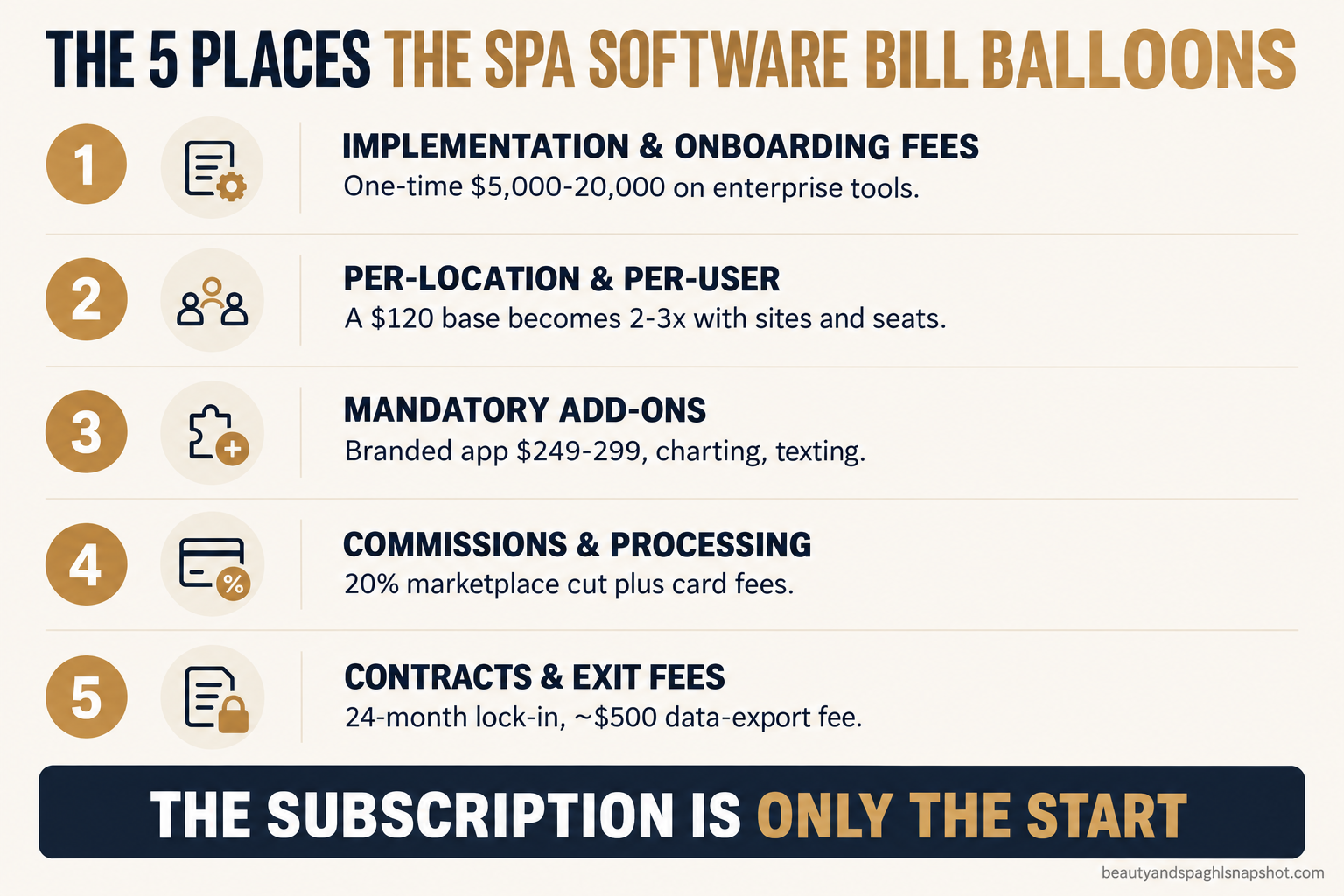
Across every vendor, the subscription is the honest number and these five lines are where the real cost hides. Know them before any demo.
1. Implementation and onboarding fees. Zenoti’s $5,000-to-$20,000 setup is the extreme, but Boulevard’s ~$495 onboarding counts too. This is money you pay before the tool does anything for you. Ask whether it is refundable if the rollout stalls, because stalls are common.
2. Per-location and per-user multiplication. A “per location” price looks small until you have four. Mangomint’s $10-per-user line does it quietly: a 12-person shop adds $120 a month in seats alone. Budget off the single-unit price and the bill lands two or three times larger.
3. Mandatory add-ons dressed as options. The branded app you “don’t need” is how clients rebook. The charting module is the only way a med spa stays compliant. Marketed as optional, they function as required, like Mindbody’s $249-to-$299 app. Price the tool with the add-ons you need.
4. Marketplace commissions and processing. Mindbody’s 20% cut on marketplace bookings and Fresha’s 20% new-client fee are performance marketing you pay per booking, not software you pay per month, so they never show up in a price comparison. Processing is the same: a 0.3% gap on $25,000 of monthly card volume is about $900 a year.
5. Contracts and exit fees. The one that traps people. A 24-month Mindbody term with auto-renew and a ~$500 charge to export your own client history means leaving costs money and time. Before you sign a term, ask in writing how long the commitment is and what it costs to leave with your data.
What it costs for a solo, a mid-size, and a chain
Averages lie. The right tool for a one-chair studio is the wrong tool for a 10-location group, and the gap between them is the whole story. Run the question through three shapes of business.
The solo operator, one chair. You do 60 to 100 appointments a month and run everything from your phone. Zenoti and Mindbody Ultimate are not just too expensive here, they are the wrong category. A $450 Zenoti bill plus a five-figure setup fee against maybe $8,000 of monthly revenue is indefensible. Your honest range is $0 to $50 a month: Square free, GlossGenius Standard at $24, or Mangomint solo at $130. Anything with an implementation fee is overbuying.
The mid-size shop, three to four providers. Now the front desk matters, no-shows cost real chair time, and you want memberships and rebooking. Live options are Boulevard around $293 per location, Mangomint at $120 plus four or five users, or Vagaro built up with add-ons. This is where the enterprise reps start calling, and a Zenoti demo quotes you $1,000-plus a month once locations and add-ons are counted. The deciding question is not the sticker, it is whether the tool chases the no-show and rebooks the client.
The multi-location chain. Eight to ten locations, mixed booth-rent and commission staff, real payroll, a central ops person. This is the one case where Zenoti’s model can pencil out, because the per-location cost is spread across real volume and the reporting earns its keep. The trap here is the contract term and the setup overrun. A 24-month lock-in on the wrong platform costs far more than any monthly fee.
Illustrative monthly software cost, 2026: a right-sized tool versus enterprise software for the same business. Solo right-sized is GlossGenius Standard; Zenoti uses the mid reported estimate. The point is the gap, not the exact dollar.
Steal this: how to force a real written quote
Hidden pricing works because the sales call is built to keep you from asking the hard questions in order. So bring them with you. Read these out in the first five minutes of any demo, and do not let the call end until you have the answers in an email.
The six questions that get you the real number:
- What is the total monthly cost for [X] locations and [Y] users, including every add-on I would actually use? One number.
- Is there a one-time setup or data-migration fee? How much, and is it refundable if we do not go live?
- How long is the contract, is it auto-renewing, and what is the early-termination penalty?
- What does it cost to export my full client list and visit history if I leave?
- What is your card processing rate, and any marketplace or booking commission on top?
- What was the actual all-in bill for a business my size last year, not the list price?
The follow-up email to send the same day (so the number is in writing):
Hi [Rep name], thanks for the walkthrough. To compare fairly, can you put the all-in number for [my business, X locations, Y users] in writing: total monthly cost with the add-ons we discussed, any setup fee, contract length and early-exit cost, data-export fee, and processing rate. Once I have that I can decide. Thanks.
If the number comes back fair for your size, you buy with eyes open. If the rep dodges, pads, or will not commit it to email, you learned the most important thing about that vendor before paying a cent. The same discipline backs our full spa software cost teardown and our comparison of nine booking tools.
Common objections, answered straight
“Isn’t Zenoti worth it if the platform is that good?” For the right business, yes. If you run eight or more locations with central operations, Zenoti’s reporting and scale can justify the cost, and the setup fee is a rounding error against your revenue. The mistake is a solo operator buying enterprise software because a demo was impressive. Match the tool to your size, not the sales pitch. A $450 monthly bill plus a $10,000 setup needs real volume behind it.
“Can’t I just negotiate the price down?” Often, yes, especially on annual billing and the implementation fee, which carries the most padding. But negotiating a hidden price is a disadvantage: you do not know the floor, and the rep does. Walk in with the six questions above and a written quote from one competitor, and you negotiate from information instead of hope.
“Why does GoHighLevel not have this problem?” Because it is priced as a platform, not per location. GoHighLevel runs a flat monthly plan ($97 to $297) covering unlimited sub-accounts, clients, and staff, so a multi-location spa does not multiply its bill by site. That is the platform our system is built on, which is how we charge a one-time build fee instead of a per-seat subscription that grows every time you hire.
“The cheap tools look fine. Why pay more at all?” Price is only half the question. A $24 tool that books appointments but never holds a deposit, chases a no-show, or rebooks a client can cost you far more in empty chairs than a pricier system that does. Count what the tool helps you earn, not just what it costs.
Frequently asked questions
How much does Zenoti cost per month?
Zenoti does not publish pricing, so figures come from third-party review sites and user reports. Estimates run roughly $200 to $600 per month per location, plus a one-time implementation fee most owners put between $5,000 and $20,000. Large multi-location chains reportedly pay $10,000 a month or more.
Why won't Zenoti show its prices online?
Because it is enterprise software priced for chains, and the number is easier to defend in a sales call than on a public page. The pricing page is a lead-capture form. A rep maps your locations, users, and add-ons, then quotes a custom figure anchored against projected revenue.
Is Zenoti worth it for a small spa?
Usually not. It is built for multi-location chains with central operations. For a solo or single-location studio, the monthly cost plus a five-figure setup fee is hard to justify against typical revenue. A flat-priced tool like GlossGenius or a platform like GoHighLevel fits a small spa far better.
What does Mindbody really cost after the add-ons?
Much more than its 'starting at $99' sticker. The real tiers run roughly $259 to $279 (Accelerate) and $499 to $699 (Ultimate) per location, plus a branded app near $249 to $299 a month, a 20% marketplace commission on app bookings, processing, and commonly a 24-month contract with a ~$500 data-export fee at cancellation.
How do I get a real price out of a vendor that hides it?
Ask for one all-in monthly number for your exact location and user count with the add-ons you will use, plus any setup fee, contract length and early-exit cost, data-export fee, and processing rate, and insist it come in an email. If a rep will not put the total in writing, treat that as your answer.
Related reading
- What salon and spa software really costs in 2026
- Fresha isn’t free anymore: the real cost and 5 alternatives
- GoHighLevel vs Mindbody: a 2026 cost and feature comparison
The bottom line
Back to that “Book a Demo” wall. It is not hiding a feature, it is hiding a number, and the number is hidden because it is large and a salesperson can frame it better than a web page can. That is true of Zenoti and, more quietly, of Mindbody. The sticker is never the bill.
So stop evaluating software on its headline. Pick the two or three tools that fit your size, send each the same written request for an all-in number, and compare the totals with add-ons, setup fee, and contract in full view. For most 1-to-3 chair studios the honest answer is a flat-priced tool plus a real system for deposits and rebooking on top. For a chain, it is a platform you have read the contract on. Either way the calendar is only half the job: the deposit hold, the no-show recovery, and the rebooking fill the chairs, and that is what we build for spas on GoHighLevel. The appointment automation and SMS automation inside ours are where that happens.