

A client finishes her first laser session. She is happy, the area looks good, and she is standing at your desk with her card already out. This is the best selling moment you will ever get with her, and most spas waste it. They ring up one session, say “see you next time,” and let her walk out with no next appointment and no reason to come back for the visits she actually needs.
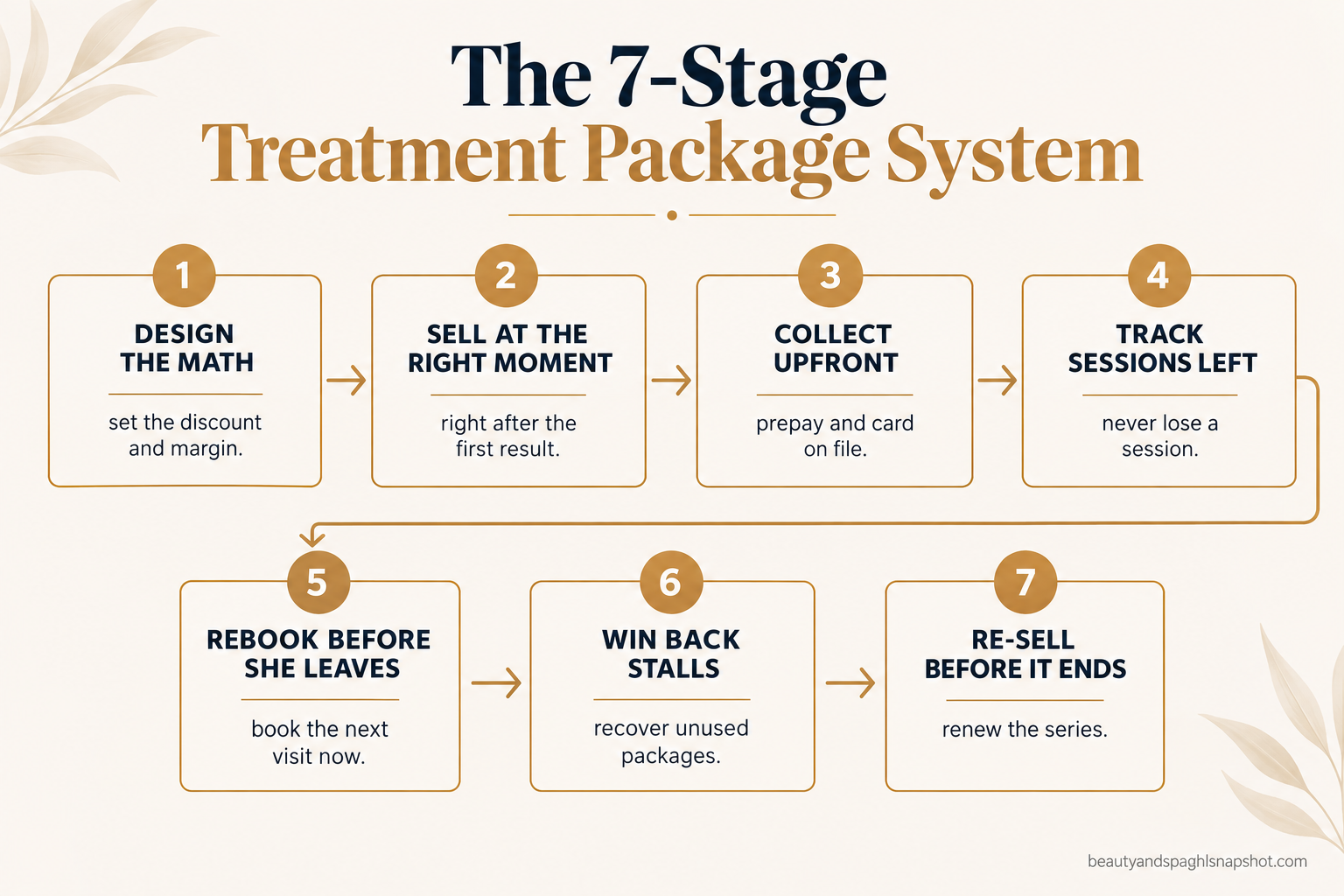
That one habit is the difference between a spa booked months ahead and one that starts every week from zero. A treatment package fixes it: you sell the whole course up front, take the money up front, and book the visits up front. Done right, it turns a one-time guest into six booked appointments and a few thousand dollars banked before she leaves the room. Done wrong, it leaks through forgotten sessions, sloppy refunds, and clients who prepay and ghost. Here is how to do it right.
Table of contents
- What a leaky package system costs you
- Package vs membership vs single visit
- Stage 1: Design the package so the math works
- Stage 2: Sell it at the right moment
- Stage 3: Collect the money up front
- Stage 4: Track what is left
- Stage 5: Rebook before she leaves
- Stage 6: Win back the package that stalled
- Stage 7: Re-sell before it runs out
- Run it for your size
- What you can legally say and charge
- Objections I hear before every launch
- Frequently asked questions
Key takeaways
What a leaky package system costs you
Packages are not a merchandising trick. They are the cleanest way to lock in the repeat visits that already pay your rent. Per the Zenoti 2025 Beauty and Wellness Benchmark Report, the 42% of clients who visit more than once a year generate around 80% of a salon or spa’s revenue. A package manufactures that second, third, and sixth visit on purpose instead of hoping for it.
Share of total salon/spa revenue by client type. Source: Zenoti 2025 Beauty & Wellness Benchmark Report.
Sources: Zenoti 2025 (revenue share); Mindbody pricing (commission); Mangomint 2026 pricing; AmSpa (industry size).
Selling single visits means paying to find a client over and over. Mindbody even charges for it directly, taking a 20% commission on new clients booked through its marketplace. A package flips that: you find the client once and bank six visits. The catch is that it only pays off if every session gets used and logged, and if you re-sell before it ends. Most spas do neither well, which is where the stages below come in. The full vendor math is in what spa software really costs.
Package vs membership vs single visit
Owners mix these up and sell the wrong one. A package is a finite, prepaid set of visits for one treatment, like six laser sessions or four peels. A membership is a recurring monthly charge that renews on its own, covered in how to build a spa membership worth $20k a month. A single visit is pay-as-you-go.
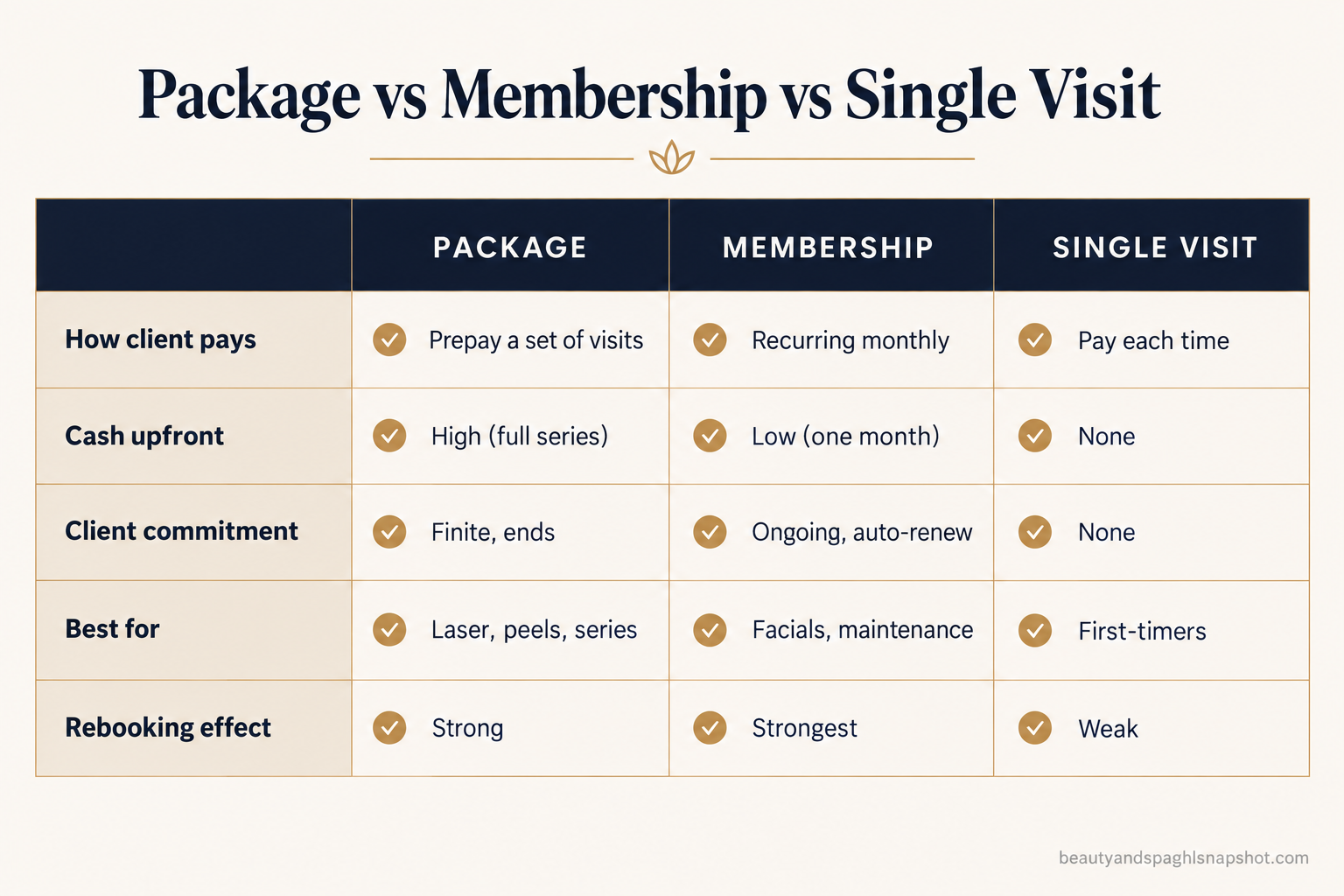
| Model | How she pays | Cash up front | Best for | Rebooking effect |
|---|---|---|---|---|
| Package | Prepays a set course | High (full series) | Laser, peels, body, lash sets | Strong |
| Membership | Recurring monthly | Low (one month) | Facials, maintenance, regulars | Strongest |
| Single visit | Pays each time | None | First-timers, one-offs | Weak |
The rule: sell a package when the treatment only works as a course of visits, and a membership when the client benefits from steady monthly upkeep. Many spas run both. This guide is the package half.
Stage 1: Design the package so the math works
Start with the clinical reality of the treatment. The American Academy of Dermatology notes that most patients need two to six laser treatments to remove hair, because the laser only catches hair in its active growth phase and that phase cycles over weeks. So laser is never really a single service. It is a package pretending to be one if you sell it by the session, and the same is true of peel series, microneedling courses, and most body-contouring protocols.
Package what the body already requires: a course of six for laser, three to four for peels, a set of six for most body work. Then price it with a small reason to prepay, roughly 10% to 15% off the per-visit rate. That rewards the commitment without gutting your margin. Go deeper and you are paying clients to buy what they were going to buy anyway.
How it breaks. Discount to the bone and a few unused sessions turn the package into a loss. Package a one-and-done service and you train clients to wait for the bundle instead of booking singles at full price. Package the multi-session treatments and leave the rest alone.
Stage 2: Sell it at the right moment
The package is sold in the treatment room, at the moment the client sees the first result and believes it will keep working, not at the register. Walk her out with the recommendation already made, and the desk just takes payment. Lead with the desk and you have turned a warm clinical conversation into a cold retail pitch, and the answer is “let me think about it.”
The script is short, specific, and honest about what the treatment needs:
"Today went exactly how I'd want a first session to go. For the
result you came in for, this works as a course of six, about four
to six weeks apart. If we book the full series today it's 15% off,
and I'll reserve your spots now so you actually finish, which is
the part that gets the result. Want me to set that up?"
That ties the package to her result, names the real number of sessions, and closes on booking.
How it breaks. The provider stays quiet and “lets the client decide,” so nobody makes the recommendation and everyone defaults to single visits. Or it gets pushy, stacking three upsells onto someone who wanted a facial. One clear, clinically honest recommendation per visit is the whole play. Script it and have every provider use the same words.
Stage 3: Collect the money up front
The entire advantage of a package is the prepayment. A client who has paid for six comes back for all six, because the money is already spent and walking away loses it. So collect the full course up front whenever you can.
When that is a stretch, offer a plan instead of losing the sale: a deposit now, say a third, with the balance split over the first few visits and a card on file. Card-on-file is non-negotiable here. It charges the plan, covers a no-show on a prepaid session, and removes friction at every visit, with the card data held by your payment processor, never a text or spreadsheet.
How it breaks. Taking a tiny deposit and “settling up later” turns your package into an interest-free loan she may never repay. Having no written refund terms means every half-used cancellation is an argument that can end up on Google. Collect real money up front and write the terms down before the first dispute.
Stage 4: Track what is left
This is where spas quietly lose the most money. A client prepays for six, and around visit four the desk loses count. Maybe she gets a seventh free because nobody logged visit three. Maybe she is told she is out after four and gets annoyed because she had two left. Both cost you, one in money and one in trust.
Every session should decrement against the package automatically the moment it is marked complete, visible to both of you, so the provider sees “session 4 of 6” before they start. If your setup cannot show that at a glance, it is a real gap, and one reason owners move to a system that treats packages as first-class objects rather than a note in the calendar. Our CRM and workflow automation keeps the count and the client history in one place.
How it breaks. The balance lives in someone’s head or on a sticky note, so it is wrong the first time that person is off sick, or two locations share a client and neither sees the other’s visits. Tie the count to the appointment status, not to memory.
Stage 5: Rebook before she leaves
A prepaid package is only worth the margin if the client completes it, and the biggest driver of completion is simple: book the next appointment while she is still at the desk. A client who leaves with the next visit on the calendar comes back. A client who leaves meaning to “call and schedule” is the one who stalls at session three with money still on the account.
So make the next booking part of every checkout, backed by reminders that reference what she has paid for:
[1 day before] Hi [First name], you're booked for session 3 of 6
tomorrow at [time]. Reply C to confirm or R to reschedule.

[2 hours after, if marked complete] That's session 3 of 6 done,
3 left on your package. Want to lock in your next visit now? [link]
That second text is the quiet workhorse: it confirms the balance, which heads off the Stage 4 argument, and rebooks on the spot.
How it breaks. A busy desk skips the rebooking, or the reminders treat a prepaid client like a cold lead, nagging her to “book your appointment” as if she has not already paid. Make rebooking a non-skippable checkout step and reference her remaining sessions. For the wider version, see why clients drop off after the second visit.
Stage 6: Win back the package that stalled
Some clients stall anyway. A client with two sessions left goes quiet for two months. That unused balance is money you have been paid for a result she has not gotten, and a client who does not finish does not re-buy. A short, human win-back recovers a surprising share:
[21 days quiet, 2+ sessions left] Hi [First name], you've still
got [X] sessions on your package and I'd hate for you to leave
results on the table. Here's my calendar, grab whatever works: [link]
This is not a discount beg. She already paid. It is a nudge from a real person who wants her to finish. Keep it warm, reference the sessions left and the expiry, and route any reply straight to a human who can book her in.
How it breaks. Nobody watches for stalled packages, so they expire unused and the client silently churns, or the win-back reads like spam and gets a STOP. Trigger it off real inactivity, cap it at two messages, and make it sound like the provider. This is the same muscle as client reactivation, pointed at a prepaid balance.
Stage 7: Re-sell before it runs out
The last session is a selling moment as good as the first. She has the result, she trusts you, and she is in the room. Say nothing and she finishes her six and drifts. Make one clean offer, a renewal or a step into a membership, and you keep her on the books. Time it to the final visit, in person and then by text:
[At the final session] "This is the last one in your package and
the results look great. Most clients keep them up with a maintenance
package or our monthly membership. Want me to set that up before you
go so you keep your spot and your pricing?"
For a results treatment like laser, the re-sell is a touch-up or maintenance package. For a facial series, the natural next step is a monthly membership, the smoother recurring revenue in the membership pricing and retention math. Either way, the ask happens at the result, not a month later.
How it breaks. The course ends with no next offer, so your most-proven client goes back to square one, or you only re-sell by text and miss the in-person moment that converts far better. Make the final-session re-sell a required step, same as the Stage 2 first offer.
Run it for your size
The system is the same. What changes is where it breaks and who owns it.
Solo operator or booth renter. You are the provider, the desk, and the person who forgets to log session three, so your risk is tracking. Use software that shows the remaining count and automate the Stage 5 reminders. If you rent a booth, keep the terms and card-on-file in your own system so the client and revenue follow you.
Mid-size team, three to eight providers. Your risk is consistency, because one provider offers the package every time and another never mentions it. Standardize the Stage 2 script, track who is offering, and keep the session count in a shared system so anyone at the desk can see “4 of 6” for any client. A written playbook and one owner of the program pays for itself here.
Multi-location chain. Your risk is leakage across sites. A package should work at any location with the balance visible everywhere, which only happens with one shared client record. Standardize pricing, refund terms, and the sequences centrally, then let each site run the playbook, piloting any change at one location first.
What you can legally say and charge
Packages touch two legal lines, especially for med-spas. The first is how you advertise results. The FTC’s endorsement and testimonial rules require that results you show, including before-and-after photos used to sell a package, be typical or clearly disclosed when they are not, and the FTC’s 2024 rule makes it an explicit violation to suppress or gate honest reviews. You can say a laser course “works as a series,” because that is clinical fact, but you cannot promise a specific outcome or imply a cherry-picked photo is the norm.
The second line is privacy. A pure day spa doing facials, waxing, and massage is generally not a HIPAA covered entity. A med-spa changes that once licensed medical providers perform medical procedures and it runs covered transactions like electronic insurance claims. Once medical staff and procedures are involved, treat intake forms, consult notes, and treatment photos tied to a package as sensitive, and keep them out of unsecured SMS and email. Your reminders can say “session 3 of 6” without naming a condition. The fuller version is in what you can legally text, post, and email in 2026.
Objections I hear before every launch
“Won’t discounting a package train people to wait for the deal?” Only if you discount the wrong things. Package the treatments that genuinely need a series, like laser or peels, where the client was always going to buy multiple visits. A 10% to 15% prepay reward on a course she needs anyway rewards commitment, it does not train her to wait. Keep one-and-done services at full price.
“What if she prepays for six and wants a refund halfway?” This is why Stage 3 writes the terms down. Refund used sessions at the full single-visit rate, so a client who used three of six gets back the difference, not half the package. Nobody argues, because it was on the receipt.
“Do I need to be technical to run this?” No. The pricing is arithmetic, the scripts are words your team already half-says, and the automations are set up once. The hard part is doing Stages 2, 5, and 7 every time instead of when someone remembers.
The takeaway
A treatment package is the most honest upsell in a spa, because it sells the client exactly as many visits as her result needs and pays you for all of them up front. The system is seven steps: price it so the margin survives, recommend it at the result, collect up front with terms in writing, track every session, rebook before she leaves, win back the stalls, and re-sell before the course ends.
Miss one and the package leaks. Run all seven and a single happy first visit becomes six booked appointments, a few thousand dollars banked, and a client who finishes and re-ups. That is how a full Tuesday stops being luck and starts being a system.
Frequently asked questions
How big should a spa treatment package be?
Package the number of sessions the treatment clinically needs, not a round number. Laser is commonly sold as a course of six because results build across several hair-growth cycles; peels and microneedling are often series of three to four. Price the full course with a 10% to 15% prepay reward.
Should I offer a package or a membership?
Use a package for a finite, results-driven course of one treatment, like laser or a peel series, where the client prepays a set number of visits. Use a membership for ongoing maintenance she benefits from monthly, like regular facials. Many spas run both.
What happens if a client wants a refund on a half-used package?
Set the terms in writing at purchase. The fair standard is to refund unused sessions only, after re-pricing the sessions already used at your full single-visit rate rather than the discounted package rate. A client who used three of six is refunded the balance, and because it was on the receipt, nobody argues.
How do I stop losing track of how many sessions a client has left?
Tie the session count to the appointment status in your software, so every completed visit decrements the balance automatically and both you and the client can see a count like 'session 4 of 6.' Never track it in memory, and reconcile active packages monthly.
Are package reminder texts allowed under TCPA?
Yes, when you follow TCPA best practice: capture consent at opt-in, identify your business, and honor STOP immediately. Reminders for appointments a client already paid for are low-risk, but you still need consent on file and a working opt-out. Keep medical detail out of the text and reference only the session number.